
Technology is Eating Itself
Something Big is Happening (to Technology)

Technique, Gestell, & the Machine
Technology is in the business of optimization—bigger, better, faster, stronger. We often associate technology with tangible objects, like a hammer or a smartphone, but philosophers alternatively conceive of technology more as a process or posture towards the world — a machine-like force with a mind of its own. German philosopher Martin Heidegger described technology as a way of seeing the world primarily guided by efficiency, utility, and control (a mode of revealing, which he calls Gestell). According to Heidegger, technology shapes our perception, prompting us to see the world as a resource to be harnessed. He warns us that this posture risks reducing nature and humanity to mere “standing-reserve,” valued only for their utility. For Heidegger, a hyperfocus on efficiency can overshadow elements of beauty, joy, and community.
French philosopher Jacques Ellul talks about technology in a similar fashion, using the term technique to describe a posture towards the world that has taken over almost every aspect of modern life and is infused throughout social systems, institutions, and culture:
…technique is the translation into action of man’s concern to master things by means of reason, to account for what is subconscious, make quantitative what is qualitative, make clear and precise the outlines of nature, take hold of chaos and put order into it.1
Humanity has long been on a journey of prioritizing ends over means, products over processes. We see this play out in digital technology’s trajectory of eating up the non-digital world. More and more aspects of everyday life have already been restructured by our digital tools:
Social media has redefined our social relationships, optimizing for scale and attention.
Standardized tests and GPAs have restructured education in the service of measurable outcomes.
Google Maps has altered our perception of the physical world, optimizing for advertising and commerce rather than orientation and discovery.
And yet technology has never existed for its own sake. Automation and optimization are not ends in themselves but means towards some further purpose. We build tools to serve human aims. But what happens when the logic of automation turns inward and begins to redefine the very processes of automation itself?
Automating Automation
With the advent of generative AI, we see this logic of optimization turning inward. Software code now writes itself with tools like Claude Code, Cursor, and GitHub Copilot. AI is automating the underlying process of technological optimization.
Through a simple prompt, AI can now build an application or perform a process that once required custom software, teams of developers, designers, and businesspeople. The very process of making digital tools is being swallowed up by AI.
Software is moving beyond the realm of durable, monolithic products, and is evolving into a platform for turning mere intent into outcome.
When software begins to self-assemble around our expressed intent, the technical aspects of software become disposable. What required months of coordination can now materialize in minutes. The impossible no longer appears impossible — only unimplemented.
Media theorist Marshall McLuhan predicted this moment, one in which “we have now only to name and program a process or a product in order for it to be accomplished.”2
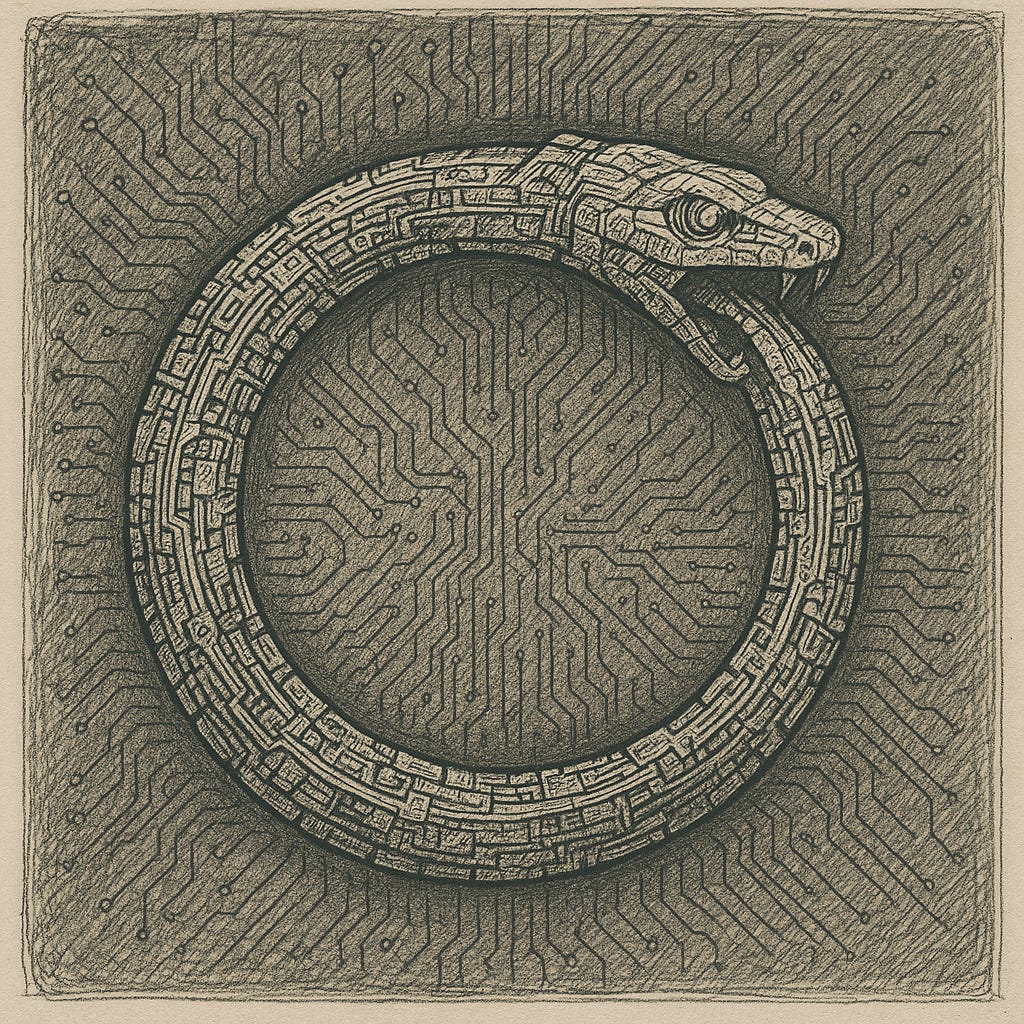
Software—the industry designed to optimize everything else—is now itself being optimized away. Automation has turned inward. Technique has begun to consume its own infrastructure.
Being Over Output
In many ways, these processes of automation have the power to free us from our servitude to the machine. For the first time in the digital age, our tools begin with our purposes rather than forcing us to understand their architecture. Automation can disrupt those things that have already been given up to optimization, like entering phone numbers in a complicated phone tree, mindless data entry tasks, or converting documents from one file type to another. These tasks are merely a trickle-down effect of Ellul’s technique, the optimization of someone else’s process at our own expense.
It’s no surprise that disruption comes first for the areas where society has conformed to the structure of our tools. But in this process of leveraging AI to help us regain a part of our humanity—by forcing our tools to conform to us and to speak our language—we must be wary of the hidden costs of automation.
The pervasive influence of technique has created in us a bias for products over processes, for ends over the means that produce them. The value of process is harder to define because it’s less quantifiable, less immediate. An open-ended embrace of automation and optimization — so easily enabled by AI — may cause us to overlook the subtle mystery of process. Something intangible is lost when we circumvent the friction of a blank page or ask an agent to “generate 50 ideas” before working out a few of our own.
In the world of AI, we need a new framework for asking what should be automated rather than assuming that everything which can be automated should be.
As humans, we’ll need to reclaim the muscle memory of what it’s like to do things for the sake of doing them, not for optimized product output. Martin Heidegger talks about this in The Question Concerning Technology, pushing us toward a more intentional, reflective participation in things that cannot be optimized.
The machines will never be able to be for you—only to produce outputs for you. So, take a walk, paint a picture (even if it doesn’t look as good as what AI can do), plant and cultivate a garden, refine your sense of taste, read a poem…
Author Wendell Berry in his poem Manifesto: The Mad Farmer Liberation Front charges us to “every day do something that won’t compute” as an act of quiet rebellion against the machine of optimization:
So, friends, every day do something
that won’t compute. Love the Lord.
Love the world. Work for nothing.
Take all that you have and be poor.
Love someone who does not deserve it.
Denounce the government and embrace
the flag. Hope to live in that free
republic for which it stands.
Give your approval to all you cannot
understand. Praise ignorance, for what man
has not encountered he has not destroyed.-Excerpt from Wendell Berry’s Manifesto: The Mad Farmer Liberation Front3
Allow technology to eat itself, regain the pursuit of what it means to actually be. Because existing as a human is something AI will never be able to do.
Later in the poem, Wendell Berry calls us to “ask the questions that have no answers.” In that spirit, as we wrestle with what it means to be human, perhaps our task is not to become more efficient or to arrive at the “right” answer, but to rediscover our humanity in the process.
Ellul, Jacques. The Technological Society. Translated from the French by John Wilkinson. With an introduction by Robert K. Merton. New York: Alfred A. Knopf, 1964. Originally published as La technique ou l’enjeu du siècle, 1954.
McLuhan, Marshall. Understanding Media: The Extensions of Man. New York: McGraw-Hill, 1964.
Wendell Berry, “Manifesto: The Mad Farmer Liberation Front,” in The Country of Marriage (New York: Harcourt Brace Jovanovich, Inc., 1973).
I love eating itself
You sound like my son ... your more philosophical and he's more technical ..