

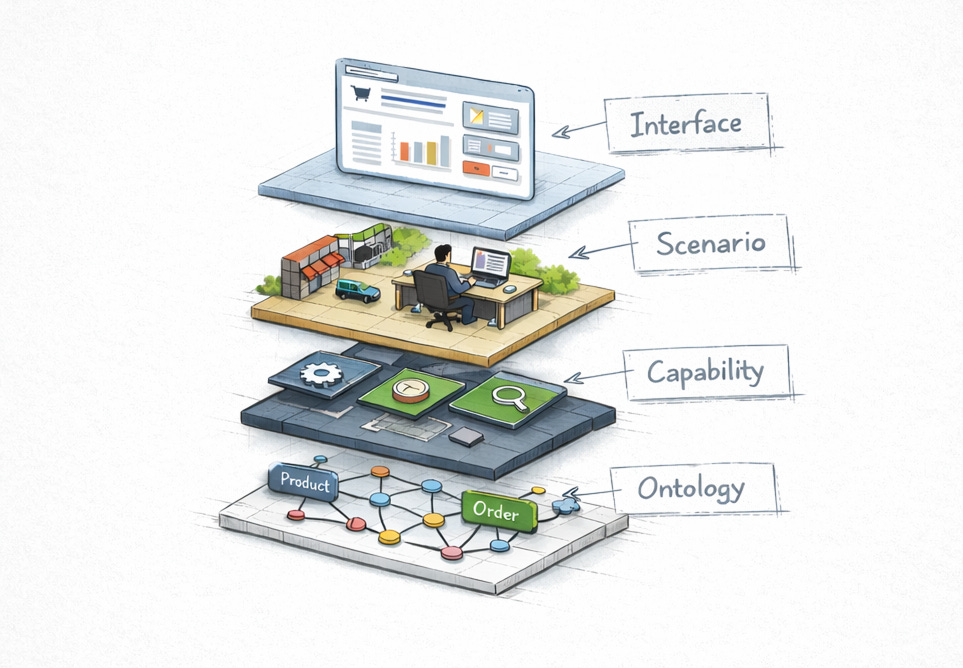
When I use the word “ontology,” what comes to mind? Philosophers will think about Plato and Aristotle 🧐; my engineering friends think in terms of OWL🦉; I think it sounds like one of Harry Potter’s classes at Hogwarts (Herbology, Ontology…) 🧙. If you’re a product designer (like me), ontology might be the most important design term you’ve never heard of.
As designers, we deal in user flows and wireframes, motion curves and design tokens. While the tools and processes of our discipline have evolved over the years, the job remains the same: turning technical complexity into something simple to use.
The advent of generative AI doesn’t change the goal of simplifying the complex, but the territory is now dramatically different. Many of us are no longer designing rigid, deterministic computing experiences, and the old playbook of mapping products around predefined user scenarios no longer fits. Instead, the probabilistic nature of large language models (LLMs) gives users something like a teleportation device, and our design process must adapt accordingly.
Language models put incredible levels of intelligence in the hands of users — the model truly does become the product, as many have noted — but this raw intelligence still needs an environment in which to take shape. It’s the role of the designer to define the conceptual world these models operate in, and the first step in doing this is to define a product’s ontology: the basic objects, relationships, and concepts that define what exists in the system.
AI does not eliminate the need for designers, but it does require the discipline to adapt as the technology evolves. Our field has already undergone several step changes as we’ve grown from pixel pushers to experience designers; now it’s time to take another step — shifting from designing screens and flows to crafting semantic worlds.
In this piece, I’ll give an overview of product ontologies as they relate to the design process, show you how to spot a good ontology from a bad one, and explore how this emerging vocabulary is reshaping the design process in the AI era.
Ontology 101
The word “ontology” comes from the field of philosophy and centers on a simple question: what does it mean for something to be? Plato explored the nature of forms and appearances; Aristotle developed ideas of categories and essence. Computer scientist Jessica Talisman — writing about information ontologies at Intentional Arrangement — helps bridge this ancient idea to modern technology:
The word “ontology” predates computer science by roughly two and a half millennia. Its roots are Greek: ontos (being) and logos (study of) …
When Aristotle asked, “what are the fundamental categories of being?”, he was doing something that modern ontology engineers do every day — deciding what kinds of things a system needs to know about, and how those things relate.1
This term has been adopted by computer scientists to describe the process of defining a shared structure of objects and relationships within an information system. Formal ontologies now serve as the backbone of modern computing experiences and play a central role in the development of agentic AI systems. Languages like OWL (Web Ontology Language) formally encode these relationships, allowing machines to reason over data rather than just store and retrieve it.
Technology takes shape through information objects and their relationships and interactions. Design is what brings this structure to life. It shapes how information moves through the system—how objects are created, transformed, connected, and experienced over time. A product’s ontology defines what exists while the design determines how those things fit together.
As designers evolve into “full-stack makers,” understanding the role of ontologies in product creation becomes essential to the task of turning technical complexity into something simple to use.
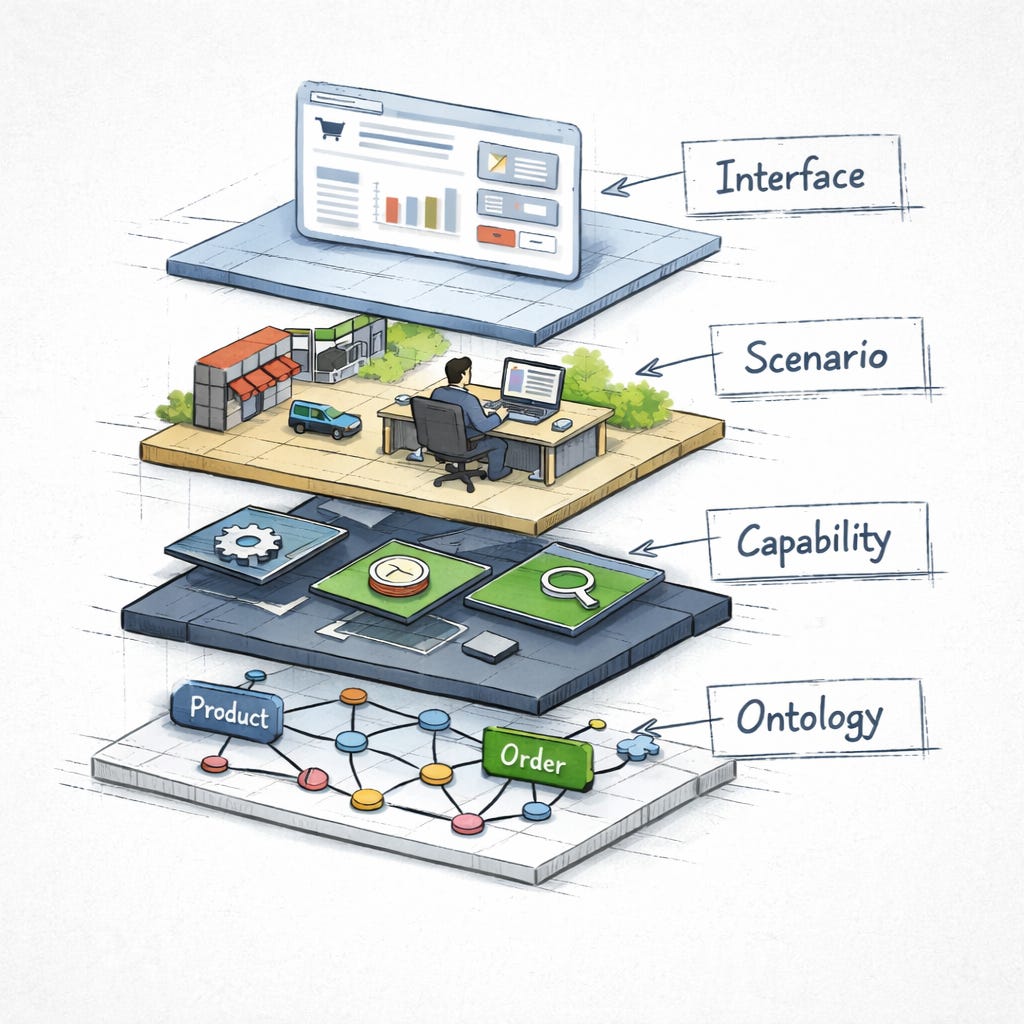
As designers, we often begin by shaping user scenarios—stories of how a person might navigate the product world we’re creating. In doing so, we’re implicitly defining the system’s ontology. But scenarios are downstream expressions of that structure, not the structure itself. Starting with scenarios can unintentionally constrain the system, anchoring it to a set of predefined use cases before its underlying structure is fully understood.
At face value, it might seem that more scenarios lead to more capabilities. But if we invert the traditional product-making process and start with the building blocks, we can create a coherent system from which a wide range of capabilities naturally emerges. Imagining scenarios without an underlying structure quickly devolves into chaos, shifting complexity onto users through systems that are fragmented and hard to navigate.
LLMs are—at their core—language technologies, so it makes sense that the words we use when designing will have a dramatic impact on the systems we create. Designers can learn from information scientists to intentionally leverage language as a way of shaping the worlds our new AI tools will inhabit. If we don’t define our product’s ontology, it will define itself. Every product has one, and its ease of use often reflects whether it has a good ontology or a bad one.
Good Ontology vs. Bad Ontology
A skilled designer can spot a bad ontology from a mile away. Good product ontologies reconcile ambiguity as a part of the design process, while bad ones transfer that complexity to the end user while calling it “capability rich.” We’ve all seen systems that are just too capable for their own good, cable TV remotes being a prime example:
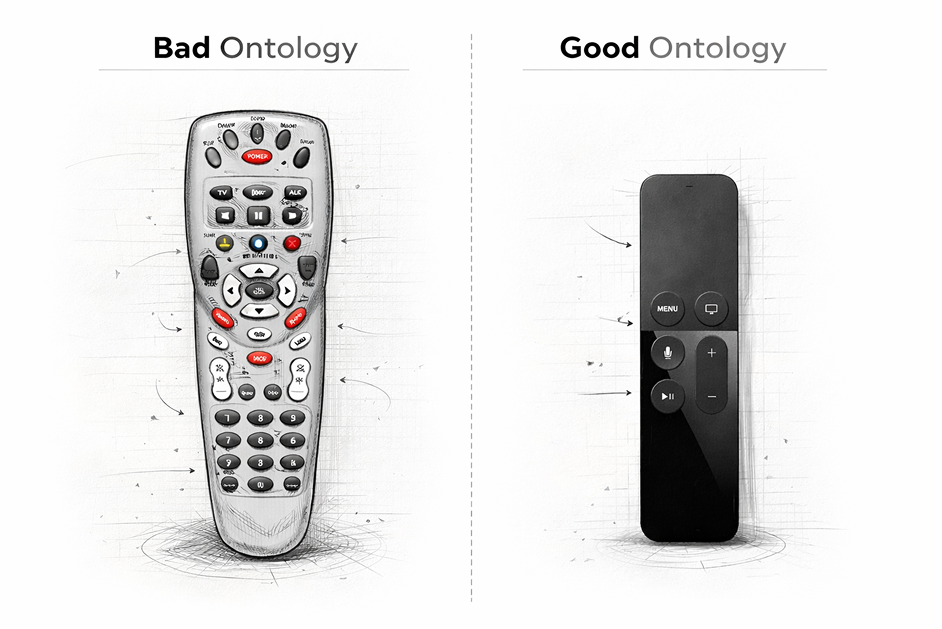
Bad ontologies force users to make sense of overlapping system constructs. If a user has to ask, “what’s the difference between a message, a post, a thread, and a page,” you’ve already lost them. This is typically the result of different product teams building scenarios in isolation without a shared language of what they’re making and how it all relates. A good ontology allows a product to take shape around user content, not the categories imposed by the product.
Products with a good ontology feel predictable because they’re built from clear, consistent objects. They’re easy to learn because actions map cleanly to those objects. And they remain flexible without becoming complex, because their primitives are designed to compose and interoperate.
When we talk about ontologies, we’re really talking about the structure of a system’s vocabulary: the nouns that define what objects exist, the verbs that describe what can be done with them, and the rules that govern how those objects change and interact over time.
Writing at Squishy Computer, Gordon Brander talks about these elements in terms of simple and complex alphabets.
Alphabets are how meaning is made…A product can serve only those use-cases its PM can imagine, but an alphabet can be used to create things beyond what any one person could have anticipated or imagined.2
Gordon describes alphabets as the objects that exist within a system along with rules of composition for combining those objects to create new things. A few examples of “simple” alphabets that enable complex but coherent outcomes: LEGO and DNA.
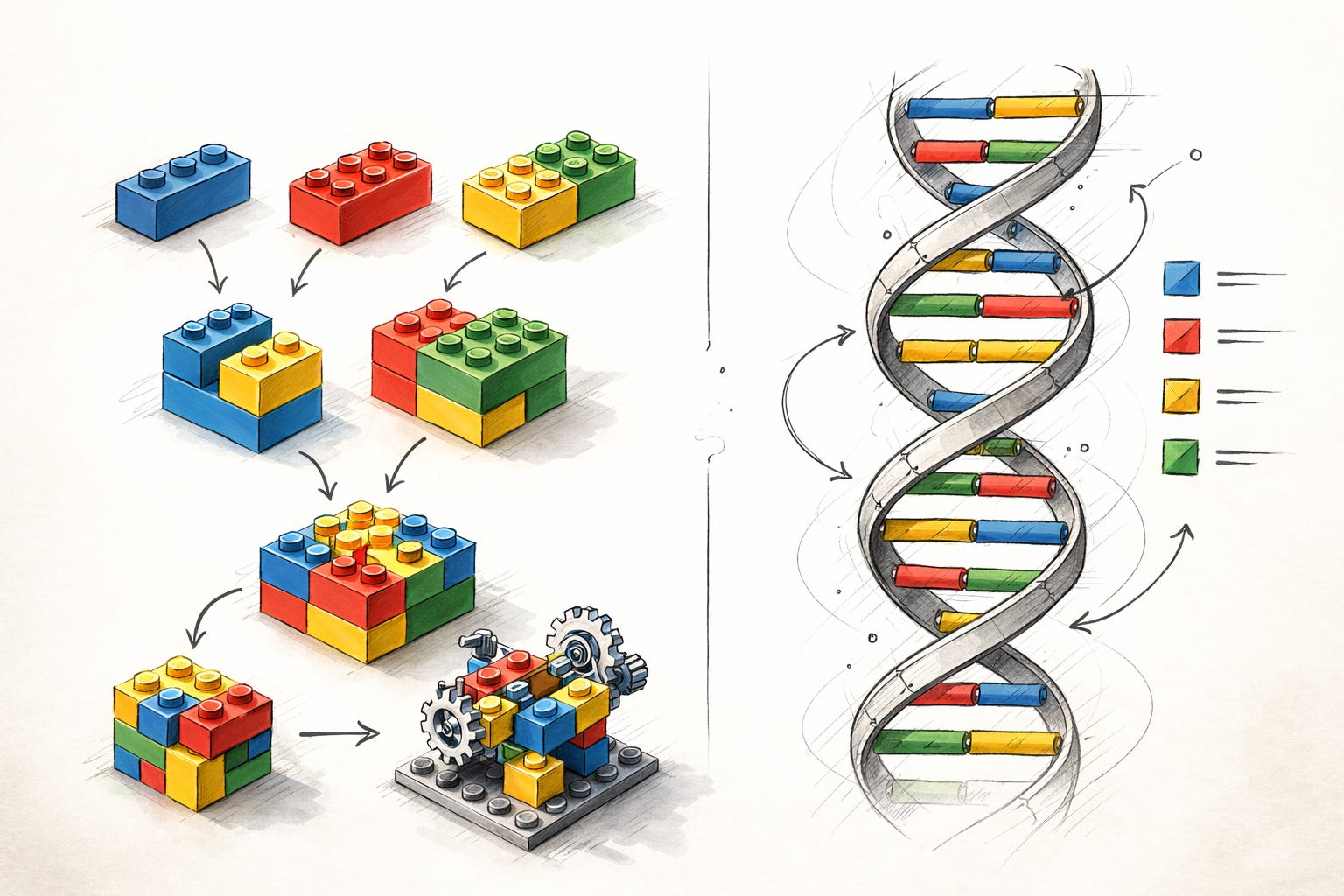
LEGO leverages simple building blocks with a consistent language of composition: the clutch power of the interlocking bricks. Similarly, DNA combines the four nucleotide bases — Adenine, Thymine, Cytosine, Guanine — to encode genetic information serving as the foundation for all carbon-based life! 3
Simple alphabets allow you to easily combine things to create new things. So instead of defining a product from a long list of scenarios or capabilities, try beginning with a small set of primitives and a language of composition and see what possibilities emerge. This will bring you one step closer to the goal of turning technical complexity into something simple to use.
Designing at the Ontology Layer
There is a lot of talk about how the role of designers is evolving for the AI era. From “frontier design teams” to “full-stack makers,” it’s hard to pinpoint what’s actually happening because this transformation is happening fast and it looks different in every context, but every conversation seems to circle back to vibe coding.
AI prototyping tools like Claude Code or Cursor are themselves built from good ontologies, simple alphabets which enable unprecedented levels of composability and customization. But the power and flexibility of these tools can also lure us into solving problems at the scenario and capability level, prematurely narrowing the possibility space of design solutions.
The real breakthrough comes when we leverage the probabilistic nature of these tools—not just to define products, but to shape the underlying meaning structures they inhabit, their semantic worlds.
Vibe coding from a solid ontology can help turn a product concept into a living, explorable system rather than a static clickthrough. This also helps collapse the distance between the raw intelligence and the interface, allowing the model to truly become the product.
Call me old-fashioned, but I start every design project with pen and paper. The ontology layer is, at its core, about the words we use to define the objects and interactions in a system. Starting in this low-fidelity space of natural language makes it easier to shape the structure of the system without LLMs prematurely introducing assumptions or answering questions you haven’t asked.
When we vibe code, we’re designing with words—and words don’t just describe a system, they define it. Every prompt implicitly constructs an ontology: objects, relationships, and rules inferred by the agent. If we don’t define that structure up front, the system will assemble one, often inconsistently.
A baseline ontology file can make that structure explicit. It becomes a shared, evolving contract between designer and agent—a simple, composable alphabet that grounds every generated feature in a coherent semantic world. Rather than prompting isolated scenarios, we define the system’s language first, and let capabilities emerge from it.
One could accomplish this with something like a Design Ontology Spec (DOS) — a lightweight, human-readable document that defines the core objects, relationships, rules, and compositional logic of your prototype’s semantic world. It acts as an evolving reference between designers and the agentic system, aligning both around a consistent semantic foundation.
dos_version: 0.1
product: Twitter-like Social System

# 1. Core Objects (Nouns)
objects:
  Tweet:
    description: A unit of public expression
    properties:
      content: string (max 280 chars)
      created_at: timestamp
      author: Person

  Person:
    description: A participant in the system
    properties:
      username: string
      joined_at: timestamp

# 2. Relationships (Verbs)
relationships:
  - Person CREATES Tweet
  - Person LIKES Tweet
  - Person REPOSTS Tweet
  - Person REPLIES_TO Tweet
  - Person FOLLOWS Person
  - Tweet REPLIES_TO Tweet
  - Tweet QUOTES Tweet

# 3. Rules (Constraints)
rules:
  - A Tweet must have exactly one author
  - A Person cannot like the same Tweet more than once
  - A reply must reference a parent Tweet
  - A Person cannot follow themselves

# 4. Composition (How things combine)
composition:
  Feed:
    description: Ordered collection of Tweets
    derived_from:
      - Tweets created by followed Persons
      - Tweets interacted with by network

  Thread:
    description: Recursive chain of Tweet replies
    structure: Tweet -> REPLIES_TO -> Tweet

# 5. System Behaviors
behaviors:
  - Liking a Tweet increases its visibility in Feeds
  - Replies inherit context from parent Tweet

# 6. Agent Guidelines
agent_guidelines:
  - Do not introduce new core objects without explicit addition to DOS
  - Prefer extending relationships over creating new primitives
  - Map all user actions to defined relationships

# 7. Anti-Patterns
anti_patterns:
  - Avoid creating “Post”, “Message”, and “Tweet” as separate objects
  - Avoid duplicating relationship types with different names

# 8. Open Questions
open_questions:
  - Should Likes be modeled as a separate object for extensibility?
  - Do we need private Tweets or visibility states?

...
Co-Designing Worlds
Design has always been a communal exercise, and collectively learning to speak the same language with our collaborators is a key part of working together. If you’re interested in going a layer deeper in the design stack, try out some of the following exercises to get used to designing at the ontology layer:
Create an Object Inventory (nouns)
Begin by listing all the foundational elements in your system. This is purely a language exercise, so avoid UI elements or features… just a list of nouns. You may notice that it’s easy for UI elements to creep into this list, which is fine, but try to think about the underlying information object. Often times, different UI surfaces are merely different expressions of simpler set of objects.
Task
Issue
Ticket
Bug
Story
Request
Comment
Thread
Activity
Notification
Update
Status
Label
Tag
Category
Priority
Assignee
Owner
Follower
Attachment
After you have this list, go through a reduction exercise. Discuss the overlaps, find any synonyms that can be collapsed or new categories that could encompass multiple existing objects:
Task / Issue / Ticket / Story / Bug / Request → "Work Item"Try forcing a constraint on the consolidation exercise (e.g. no more than 5 objects)
Describe Actions and Relationships
Once you have the core objects of the system, create a map of how they relate. This can be done as a list of relationships, like below, or even through a visual word map exercise. For the Twitter example, this might look something like:
User → creates → Tweet
Tweet → replies to → Tweet
User → follows → User
This stage is also a good place to stress test the verbs and consider if they feel natural to the objects as they’ve been defined. If my object is a “tweet,” do these verbs feel natural to that object? Do they compose cleanly? Are they applied consistently?
Create Provenance Maps
As discussed earlier, technology takes shape through the objects and relationships within an information ecosystem, and through how those elements evolve over time. Provenance is the record of where something comes from and how it changes.
Just as user journey maps describe how the humans would navigate the system around a particular task, an object provenance map is an artifact which traces how information flows throughout the system and adapts as it interacts with other objects in the system. A simple provenance map may look something like this:
object: "<noun>"

provenance:
  - "came from → ___"
  - "changed by → ___"
  - "became → ___"
  - "moved to → ___"
  - "is now → ___"
These are just a few starting points as you start to think like an information scientist and unpack how these elements take shape at this new layer of the design stack.
Conclusion
The words we use when designing have always mattered. But as we move from static screens to semantic worlds, language—and our ability to wield it—becomes the designer’s most powerful tool.
Becoming a “full-stack maker” isn’t just about vibe coding in #YOLO mode. It’s about learning to work one level deeper by intentionally designing the layer where systems take shape through language.
AI language technologies are incredibly powerful. The designer’s role is still to make that power usable, but the path has changed. As our tools and products become less deterministic, our process must evolve with them. This begins with ontology: the structure of language that defines what can exist, and what can happen, within the worlds we create.
How do you see the role of design evolving in this new era of product making?
How has your design process changed as tools become more language-driven?


This notion is consistent with John Gall’s Law which asserts that “A complex system that works is invariably found to have evolved from a simple system that worked”
The line I would underline is that scenarios are downstream expressions of the structure, not the structure. Teams hand a model a pile of user stories and then wonder why behavior drifts the moment someone walks off the golden path. The objects and relationships were never decided, only implied by the flows. Design is the right place for that argument, since designers are the ones who have to explain what a thing is to a person. I would add one test for a good product ontology. Can the system say no? If a user asks for something the ontology does not permit, does it refuse for a stated reason, or improvise a plausible object? The refusal is where the model becomes the product's judgment instead of its guess.
Wow! a well-written and excellent resource!